When the Nervous System Stays on Alert
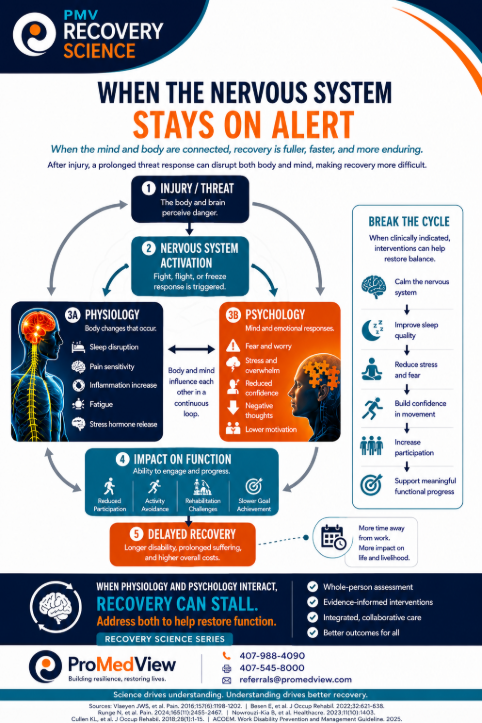
When the brain perceives threat, the nervous system activates a protective response. In the short term, that response is adaptive. But when the sense of threat persists, the body can remain in a heightened state of activation even as the original injury is being treated.
That prolonged activation can affect sleep, pain sensitivity, fatigue, attention, stress physiology, emotional regulation, confidence, and willingness to move or participate in rehabilitation.
And these effects can reinforce one another.
Poor sleep can increase vulnerability to pain, while pain can further disrupt sleep. Research supports this reciprocal relationship between sleep and musculoskeletal pain.
Fear and heightened threat perception can influence behavior and participation. Reduced activity or avoidance can then make it harder to rebuild confidence and function.
This is where the distinction between psychology and physiology begins to disappear.
The psychological response affects the physiological response.
The physiological response affects the psychological response.
Both influence function.

For workers’ compensation, that matters because the ultimate goal is not simply symptom reduction. It is functional recovery.
When clinically indicated, identifying psychological and physiological barriers to recovery can help interrupt this cycle, improve participation in rehabilitation, and support meaningful progress toward function and return to work.
When the mind and body are connected, recovery is fuller, faster, and more enduring.
Why this matters in workers’ compensation
A worker who appears to be progressing slowly may not simply need “more time.” Persistent pain, disrupted sleep, heightened threat response, fear, reduced confidence, and avoidance can interact in ways that interfere with rehabilitation.
Recognizing those factors earlier gives the treatment team an opportunity to address barriers rather than allowing them to become part of a prolonged recovery pattern.
That is the science behind whole-person recovery.
Scientific Resources
• Runge N, et al. The bidirectional relationship between sleep problems and chronic musculoskeletal pain: a systematic review with meta-analysis.PAIN. 2024;165(11):2455-2467.
• Babiloni AH, et al. The Impact of Sleep Disturbances on Endogenous Pain Modulation: A Systematic Review and Meta-Analysis.The Journal of Pain. 2024;25(4):875-901.
• Whibley D, et al. Sleep and Pain: A Systematic Review of Studies of Mediation. Review of the interconnected pathways between sleep, pain, mood, anxiety, fatigue, cognition and cortisol reactivity.
• Runge N, et al. Systematic review evidence also supports prospective associations between sleep problems and chronic musculoskeletal pain.
ProMedView | Building Resilience. Restoring Lives.
Workers’ Compensation Behavioral Health
📞 407-988-4090
📠 407-545-8000
✉️ referrals@promedview.com
🌐 promedview.com
#PMVRecoveryScience #WorkersCompensation #BehavioralHealth #Biopsychosocial #Neuroscience #PainScience #Recovery #ReturnToWork #WholePersonCare